
A person who uses a wheelchair is not disabled by their legs alone. They are disabled when a building has only stairs.
A person with autism is not disabled simply because they communicate differently. They are disabled when schools, workplaces and society refuse to adapt.
A young adult with an intellectual disability is not incapable of working. They become excluded when employers assume they have nothing valuable to offer.
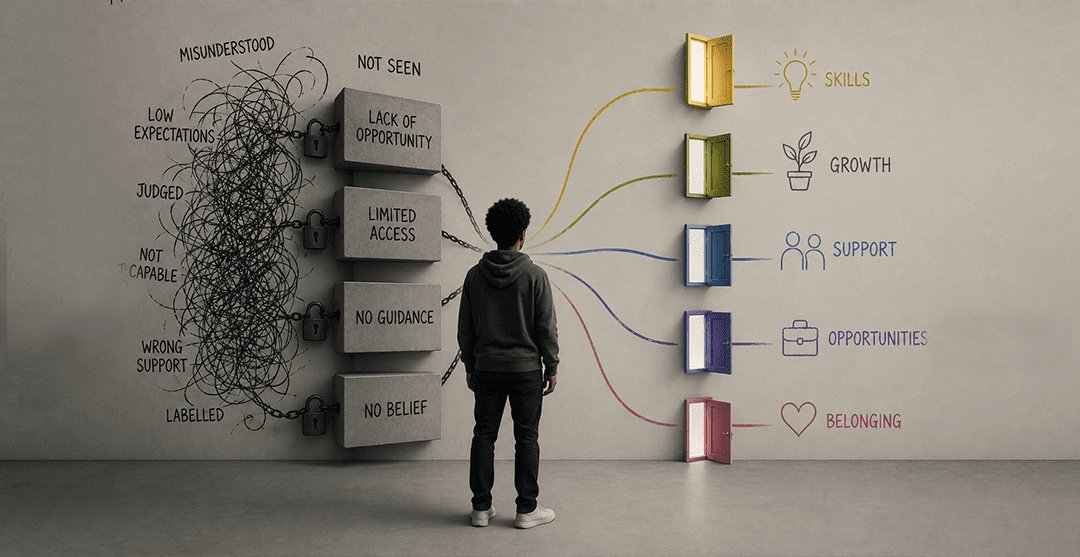
This is the heart of thesocial model of disability – the idea that people are often disabled more by society and environmental barriers than by their actual impairment.
For many years, disability was viewed mainly through a medical lens. Society focused on what was “wrong” with the individual and how they could be “fixed.” But the social model challenges this way of thinking. It asks a powerful question:
What if the problem is not the person, but the environment around them?
This shift in thinking changes everything. It changes how we view education.
It changes how we view employment. It changes how we treat neurodivergent individuals and people with intellectual disabilities. Most importantly, it changes how we build inclusive communities.
At organisations like The Living Link, this philosophy is not just theory – it is put into practice every day through occupational therapy principles, vocational training, life skills development, and supported employment opportunities that empower young adults with intellectual disabilities to participate meaningfully in society.


What Is the Social Model of Disability?
The social model of disability separates two important ideas:
- Impairment
- Disability
An impairment may refer to:
- intellectual disability
- learning impairement
- autism (ASD)
- dyslexia
- processing disorders
- ADHD
- physical disability
- sensory impairment
- mental health condition
But according to the social model, the impairment itself is not always what disables a person. Instead, disability is created when society fails to accommodate different needs.
For example:
- A learner with ADHD is disabled by rigid classrooms that expect all students to sit still for hours.
- A Deaf person is disabled when no sign language interpreter is available.
- A person with autism is disabled by overwhelming sensory environments and inflexible communication expectations.
- A young adult with an intellectual disability is disabled when employers refuse to offer support or reasonable accommodation.
The issue is not always inability. Often, it is inaccessibility. Inaccessiblity to things society deems as normal and assumes all have been exposed to.
Systemic Disadvantage and Social Disability
Certain groups are already disadvantaged due to systemic inequality.
This includes people affected by:
- racism,
- poverty,
- unequal education systems,
- gender inequality,
- disability discrimination,
- and lack of access to resources.
When social disability overlaps with these disadvantages, exclusion becomes even more severe.
For example:
- A wealthy child may access therapy and specialised schools.
- A poor child with the same needs may receive no support at all.
One child gets accommodations. The other gets punished. That difference changes lives.
1. Poverty Makes Everything Worse
Social disability becomes even more difficult when combined with poverty.
People living in poverty often have limited access to:
- healthcare
- therapy
- educational support
- assessments
- assistive technology
- transport
- mental health services
Many children remain undiagnosed for years simply because their families cannot afford support.
Instead of receiving help, they are labelled:
- naughty
- lazy
- disruptive
- difficult
- unintelligent
Poverty can also increase exposure to:
- trauma
- violence
- food insecurity
- unstable housing
- chronic stress
These experiences affect emotional, and psychosocial development significantly. A child cannot focus on classroom participation when they are worried about survival. A child can not develop appropriate communication skills when they can not understand their diagnosis, trauma or the accommodations they require to thrive.
2. How Social Disability Affects Childhood Development
Childhood is where people learn how to interact with others, build friendships, communicate, regulate emotions and develop confidence. When a child experiences social disability, these developmental milestones may become much harder.
a. Difficulty Making Friends
Some children struggle to:
- start conversations
- maintain friendships
- understand jokes or sarcasm
- read body language
- join group activities
This often leads to loneliness and exclusion. Other children may see them as “strange” or “different”, even when they are simply processing the world differently.
b. Bullying and Social Rejection
Children who behave differently are often targeted. A child who avoids eye contact, speaks differently, struggles emotionally or reacts strongly to sensory overload, may become an easy target for bullying. Unfortunately, schools often focus heavily on academic performance while emotional and social struggles go unnoticed. A child can pass tests while silently falling apart socially.
c.Emotional Development
Repeated rejection affects self-esteem.
Children who constantly feel misunderstood may begin to believe:
- “Something is wrong with me.”
- “Nobody likes me.”
- “I’ll never fit in.”
Over time, this can contribute to anxiety, depression, emotional shutdown, aggression and social withdrawal. Some children stop trying altogether.
3. Education: When Schools Are Built for One Type of Learner
Traditional education systems are often designed for students who:
- learn in standard ways
- communicate confidently
- sit still for long periods
- work well in groups
- cope easily with social pressure
But not everyone learns this way. For learners with social disabilities, school can feel exhausting rather than educational.
The Classroom Struggle Nobody Talks About
A learner may understand the work perfectly, be intelligent and creative, and have strong practical skills, but still struggle because thesocial environment becomes overwhelming.
For example:
- group projects may create anxiety
- oral presentations may feel impossible
- noisy classrooms may cause sensory overload
- unclear or fast paced instructions may create confusion
- social expectations may become mentally exhausting
- standardised assessments or testing methods may not showcase the strengths
But not all learners process and interact with information in the same way.
Some learners thrive through:
- practical learning,
- repetition,
- visual instruction,
- experiential activities,
- movement-based learning,
- or smaller support structures.
Teachers sometimes mistake these struggles for laziness, disrespect, bad behaviour or lack of motivation. In reality, the learner may be trying twice as hard just to survive the school day.
When Education Excludes Instead of Includes
Many schools unintentionally exclude students with social disabilities.
This happens when:
- support systems are unavailable
- teachers lack training
- classrooms are overcrowded and not accessible
- differences are punished instead of accommodated
- emotional needs are ignored
Some learners eventually drop out – not because they are incapable, but because they are unsupported. Others leave school believing they are deemed “stupid”, when they were simply never taught in a way that worked for them. And this creates long-term consequences.
4. The Link Between Social Disability and Employment
Many adults with social disabilities struggle to find or maintain employment. Not because they lack ability but because workplaces often value:
- strong literary skills
- fast communication
- networking
- multitasking
- quick adaptability
Modern workplaces are heavily social environments. Job interviews especially can disadvantage people with social disabilities.
Think about it:
A job interview often measures:
- social confidence
- small talk
- body language
- quick responses
- communication style
- flexibility
But does that really measure someone’s ability to do the actual job? Someone may be highly intelligent, hardworking, detail-oriented, creative, loyal and technically skilled, yet fail an interview simply because they communicate differently.
The Workplace Mask
Many neurodivergent adults spend years “masking” – forcing themselves to appear socially typical in order to survive professionally.
Masking may involve:
- copying facial expressions
- rehearsing conversations
- hiding sensory discomfort
- pretending to understand social cues
- suppressing natural behaviours or stims
- not asking questions that will make them seem “different” or “incompetent”
It is exhausting. Imagine acting in a play for eight hours every single day. Eventually, burnout happens. Many experience chronic stress, anxiety, depression, exhaustion or workplace burnout because they spend so much energy trying to appear “normal” instead of being who they are and being accepted and accommodated.
Social Disability Is Not a Personal Failure
One of the most harmful myths is the belief that people with social disabilities simply need to:
- “try harder,”
- “be more confident,”
- “stop making excuses.”
But social disability is real. And people cannot simply “positive-think” and “work hard enough” themselves out of barriers created by society.
In many cases, small changes could make a massive difference:
- flexible teaching methods
- sensory-friendly environments
- clearer communication
- patience
- accessible workplaces
- mentorship
- emotional support
- inclusive education
Inclusion is not charity. It is basic human dignity.
So What Can Society Do Better?
- Listen Without Judgement
- Not everyone communicates in the same way. Some people need more time, different methods, or alternative forms of expression.
- Stop Equating Confidence With Intelligence
- Quiet people are not automatically incapable. Social skills do not determine worth.
- Make Education More Flexible
- Different learners need different teaching methods. Inclusion benefits everyone.
- Create Supportive Workplaces
- Flexible communication styles, mentorship, routine, and accommodations can help people thrive.
- Teach Children About Difference Early
- Children become more accepting when they understand diversity from a young age.
- Believe People About Their Experiences
- Many individuals spend years masking their struggles because they fear being dismissed.
Final Thoughts: A Society Built for Everyone
Social disability is not rare. It is simply misunderstood. There are children sitting silently in classrooms right now believing they are broken because they struggle socially. There are adults forcing themselves through workplaces that drain them emotionally just to survive financially. There are brilliant, creative, capable people being excluded simply because they communicate differently. And there are vulnerable communities carrying the heaviest burden of all because inequality makes support inaccessible. The goal should not be to force everyone to behave the same way. The goal should be to build a society where different ways of learning, communicating, thinking, and existing are accepted and supported. Because inclusion is not about “fixing” people. It is about removing the barriers that stop people from fully participating in life. And sometimes, the most disabling thing in the world is not a condition – it is being constantly misunderstood.