
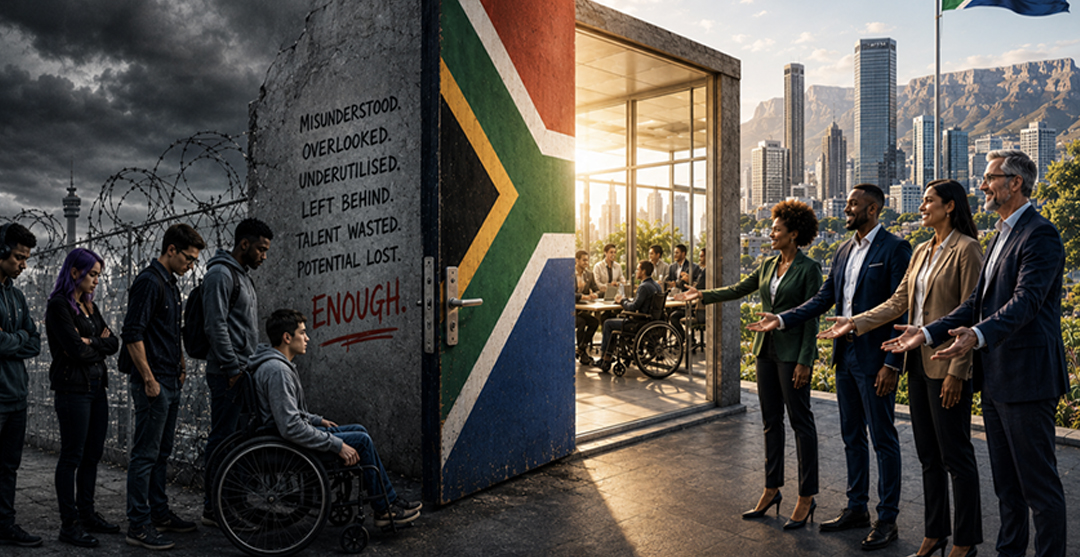
South Africa stands at a crossroads. We are a nation that speaks proudly about equality, transformation, diversity, and human rights, yet thousands of people with disabilities and neurodiverse individuals remain locked outside the economy not because they lack talent, intelligence, or potential, but because society continues to deny them access to opportunity. This is not only a disability issue. It is a leadership issue, a social justice issue, and ultimately, a human issue.
The Barriers Facing Neurodiverse Individuals in South Africa
Across South Africa, countless young people living with intellectual disabilities, autism, ADHD, learning disabilities, psychosocial disabilities, and other forms of neurodiversity wake up every morning with the same desire as everyone else: to belong, to contribute, to grow, to earn an income, and to build meaningful lives. But before many of them even reach a workplace interview, the door is already closed. Not because they are incapable, but because society has already decided what they can or cannot become.
Too many workplaces still view disability through the language of limitation instead of possibility. Too many employers focus on support needs before they recognize strengths. Too many capable individuals are excluded before they are ever given the opportunity to participate meaningfully in the world of work. Many people with disabilities are not rejected after failing. They are rejected before even being given a chance.
Behind every ignored email requesting workplace exposure is a young person waiting for opportunity. Behind every postponed meeting is a family trying to hold onto hope. Behind every organization unwilling to participate in workplace inclusion is another capable individual pushed further away from independence and dignity. South Africa cannot continue speaking about inclusion while keeping workplace doors closed. We cannot celebrate diversity in campaigns and conferences while excluding people from actual workplaces.
Why Inclusion Without Opportunity Is Meaningless
Inclusion without opportunity is empty. Far too often, disability inclusion has become a slogan, a poster, a policy document, or a social responsibility campaign without meaningful action attached to it. Meanwhile, thousands remain excluded from economic participation and meaningful workplace experience.
How Job Sampling Creates Real Inclusion
But across communities throughout South Africa, something powerful is quietly happening. A different future is beginning to emerge. Schools of Skills, NGOs, inclusive programmes, families, and a growing number of courageous employers are proving that meaningful inclusion is possible. They are proving that when people with disabilities are given access to real workplace environments throughJOB SAMPLING, transformation happens. Not symbolic transformation, but real human transformation.
Job sampling is becoming one of the most powerful yet overlooked tools for inclusive employment in South Africa because it moves inclusion from theory into reality. It allows individuals to participate in real workplaces instead of remaining isolated within systems that often underestimate them. It creates practical exposure to workplace culture, communication, teamwork, responsibility, time management, and independence. Most importantly, it creates belonging.
Why Workplace Exposure Changes Lives
For many trainees, job sampling becomes the first time they are seen not as dependents, beneficiaries, or problems to manage, but as contributors with value. That moment changes everything. A young autistic trainee who once struggled with communication slowly begins interacting confidently with customers. Someone with an intellectual disability who initially required constant support may eventually begin completing workplace responsibilities independently. A person who spent years socially withdrawn may begin building relationships, confidence, and purpose within a workplace environment.
These moments may appear ordinary to outsiders, but for many individuals and families, they are life-changing. Confidence cannot grow in isolation. People grow through participation, through opportunity, through responsibility, and through being included in spaces where society once told them they did not belong.
Breaking the Cycle of Exclusion
This is why South Africa urgently needs greater investment injob sampling programmes. In a country where work experience often determines employability, job sampling creates one of the few practical bridges between training and long-term employment for people with disabilities and neurodiverse individuals. Without workplace exposure, many individuals remain trapped in a painful cycle: no opportunity because there is no experience, and no experience because there is no opportunity. Job sampling breaks that cycle.
It introduces people to the realities of work while allowing employers to discover potential they may never have recognized otherwise. Trainees participating in job sampling programme contribute within offices, retail stores, cafés, warehouses, libraries, schools, hospitality spaces, community organizations, and small businesses. These placements may seem small on the surface, but their impact reaches far beyond the workplace itself. Families begin to regain hope. Communities begin to shift their perceptions. Individuals begin to believe in themselves again. Workplaces begin to understand that inclusion is not impossible it is simply intentional.
Why Inclusive Workplaces Benefit Everyone
Yet despite these positive outcomes, many businesses continue to hesitate. Some fear reduced productivity. Others fear discomfort, supervision requirements, or workplace adaptation. Some simply avoid the conversation altogether. But the irony is undeniable. The businesses willing to open their doors are often the same businesses that discover untapped talent, stronger workplace culture, deeper empathy among staff, and more meaningful teamwork. Inclusive workplaces do not become weaker. They become more human. And humanity is something South African workplaces desperately need.
Understanding Neurodiversity in the Workplace
South Africa also urgently needs a broader understanding of neurodiversity. Neurodiversity recognizes that people think, communicate, learn, and experience the world differently. Conditions such as autism, ADHD, dyslexia, Tourette syndrome, and intellectual disabilities are not flaws to erase. They are part of human diversity. Many neurodiverse individuals possess strengths that workplaces desperately need creativity, innovation, consistency, honesty, deep focus, attention to detail, resilience, and unconventional problem-solving abilities.
The real problem is not neurodiversity. The problem is environments unwilling to adapt. Too many workplaces continue expecting every individual to think, communicate, and function in exactly the same way. Inclusive employment requires employers to stop asking whether individuals can fit perfectly into existing systems and start asking how workplaces themselves can become more accessible and supportive.
Inclusion Is About Removing Barriers, Not Lowering Standards
That shift changes everything because inclusion is not about lowering standards. It is about removing unnecessary barriers that prevent capable people from succeeding.
South Africa Needs More Than Awareness Campaigns
South Africa must also confront an uncomfortable truth: too many organizations speak passionately about diversity and transformation while creating very few meaningful opportunities for people with disabilities. Real inclusion is not measured by awareness days or social media campaigns. It is measured by access, participation, workplace exposure, and whether people with disabilities are visible within internships, workplace readiness programmes, learnerships, and employment opportunities.
People With Disabilities Do Not Need Pity, They Need Pathways
People with disabilities do not need pity. They need pathways. They need workplaces willing to invest in possibility instead of fear. They need opportunities to develop skills, confidence, independence, and identity through meaningful workplace participation. Most importantly, they need a society willing to recognize that disability and neurodiversity are not barriers to contribution when support, opportunity, and inclusion exist together.
South Africa cannot afford to waste the potential of millions of people. Not economically. Not socially. Not morally. The future of this country will not be built only by those who already have access. It will also be shaped by those who were once excluded but finally given the opportunity to participate meaningfully within society.
Every Open Door Changes a Future
That is whyjob sampling matters. Because every placement changes more than one life. It changes families, communities, workplaces, perspectives, and futures. Every time a workplace opens its doors, stereotypes begin to break. Every time a trainee is trusted with responsibility, confidence begins to grow. Every time inclusion moves beyond conversation into action, South Africa moves one step closer to becoming the country it claims to be.
But we cannot keep speaking about inclusion while capable people remain excluded from opportunity. South Africa does not need more conversations without action. It needs workplaces willing to participate. It needs businesses willing to move beyond compliance. It needs public and private sectors willing to invest in job sampling programmes, supported workplace exposure, inclusive skills development, accessible transport, and long-term pathways toward employment.
It needs communities willing to stop seeing disability as the end of possibilities. Most of all, it needs courage, the courage to open doors, the courage to challenge assumptions, and the courage to create workplaces where every person has the opportunity not only to survive, but to contribute meaningfully.
Because inclusive employment is not charity. It is justice. It is economic empowerment. It is human dignity. And every workplace that chooses inclusion becomes part of building a South Africa where opportunity and belonging are not reserved for a few, but shared by all.
Every workplace placement matters. Every opportunity creates possibility. And every open door brings South Africa closer to the inclusive future it has promised for far too long. The question is no longer whether inclusion matters.